The sBUSPro Protocol Explained for Hotel Automation

The sBUSPro protocol is a serial bus communication system that lets lighting, air conditioning, curtains, door locks, and sensors in a hotel talk to each other over a shared pair of wires. It is the wired backbone behind the Smart G4 and Smart-Bus family of guest room management products, and it belongs to the same category of building automation protocols as KNX and BACnet.
This guide explains what sBUSPro does, how its wiring and addressing work, and why an open bus approach matters when you are fitting out dozens or hundreds of guest rooms. If you are evaluating a hotel automation protocol for a new property or a refit, the sections below cover the practical points that affect cost, reliability, and future expansion.
What Is the sBUSPro Protocol and How Does It Differ From KNX?
sBUSPro is a device-to-device bus protocol that runs over a wired serial link and moves short command messages, such as "dim this light to 40 percent" or "set this room to 22 degrees." It sits in the same family as KNX and other building buses, but its ecosystem is built around Smart-Bus and Smart G4 hardware rather than a multi-vendor standards body.
The clearest point of comparison is KNX, which is an international open standard registered as ISO/IEC 14543-3 and supported by hundreds of manufacturers. KNX gives you broad brand choice at the cost of per-device certification fees that tend to raise hardware prices. sBUSPro takes a narrower route: one coherent product ecosystem designed to interoperate out of the box, which keeps device costs down while still giving you a genuine wired bus rather than a closed, panel-locked system.
Proprietary buses from larger automation brands often go further in the other direction. They lock each room to a single vendor's controller and pricing, so every expansion or spare part flows through that one supplier. sBUSPro aims for the middle ground: a defined protocol, a catalogue of compatible devices, and wiring that any trained installer can follow. For a broader primer on the room systems these protocols drive, see what a guest room management system is.
How Does sBUSPro Wiring and Device Addressing Work?
sBUSPro runs on an RS-485 physical layer, the same balanced two-wire serial standard used across industrial and building controls for decades. RS-485 uses differential signalling and a linear bus, or daisy-chain, topology, which means devices connect one after another along a single cable run rather than each returning to a central hub (RS-485 overview, Wikipedia).
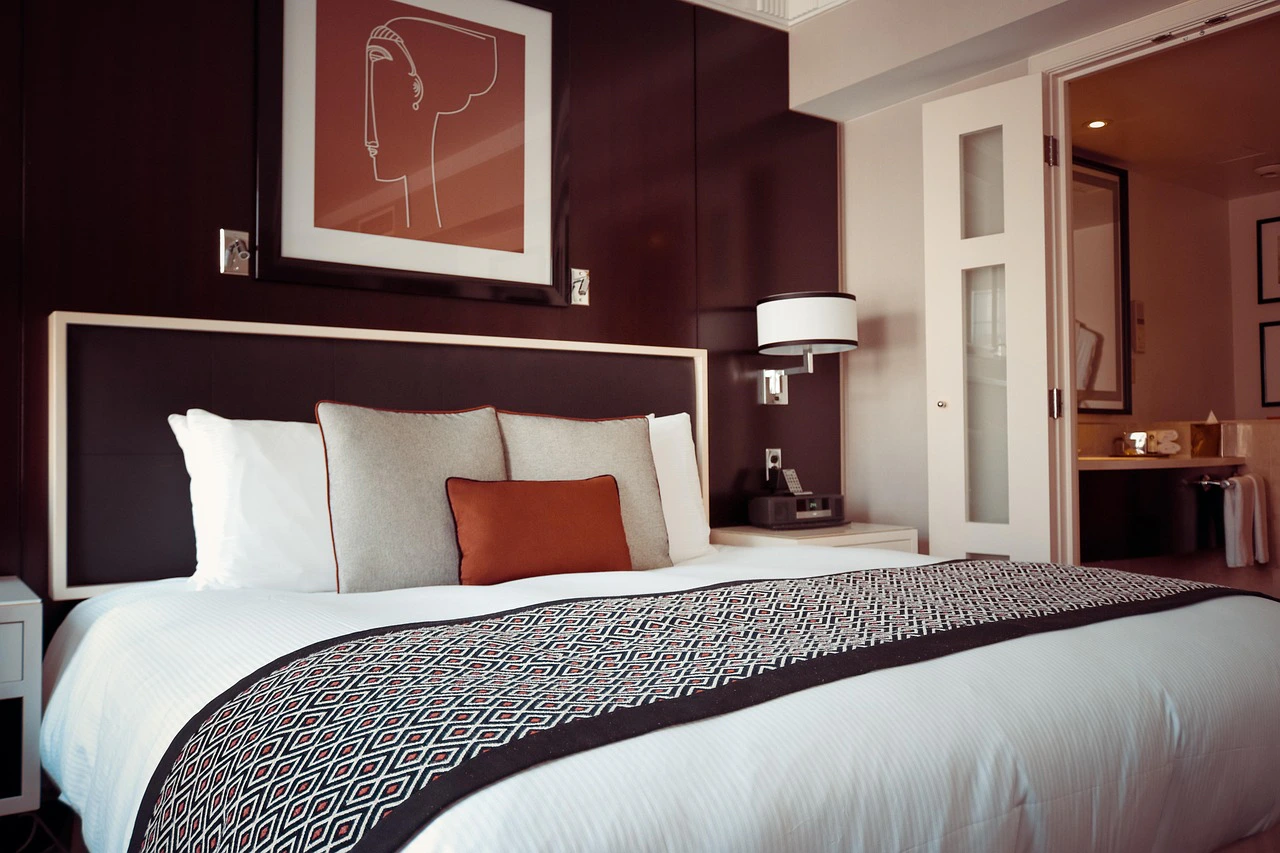
In a hotel, that usually means the bus cable enters a guest room, loops through the thermostat, the lighting controller, the curtain module, and the door panel, then carries on to the next room. There is no star of individual cables fanning back to a panel, so cable runs stay short and predictable.
Addressing is where the protocol stays easy to manage. Every device on an sBUSPro network carries a subnet ID and a device ID. The subnet groups a set of devices, often by floor or zone, and the device ID identifies a single unit within that group. When an installer commissions a room, they assign these two numbers, and the controller then reaches any device by that pair. Swapping a faulty module later means matching one address rather than re-tracing wires.
Why Does an Open Bus Protocol Lower Hardware and Expansion Costs?
An open bus lowers cost in two places: the price of each device and the labour to grow the system. Because sBUSPro devices share one documented protocol, any compatible module can join the line, so a property is not forced to buy a single vendor's premium controller for every function.
Expansion is the bigger long-term saving. On a home-run system, adding a new load often means pulling fresh cable all the way back to a crowded panel. On a daisy-chain bus, you extend the existing run or tap the nearest node, then give the new device a free subnet and device ID. The wiring effort is small, and the software simply learns one more address.

This matters for hotels because guest rooms are repetitive by design. Once the wiring and addressing pattern for one room is set, it repeats across the whole floor, and the floor repeats across the building. Predictable, repeatable rooms keep both the first install and every later change affordable. If you are weighing this open approach against a well-known brand, our comparison of Smart G4 and Honeywell GRMS walks through the trade-offs for a hotel buyer.
Is sBUSPro Reliable and Scalable for Large Hotel Deployments?
A wired bus is well suited to large deployments because it does not depend on wireless range or a shared radio channel inside dense, concrete buildings. RS-485 differential signalling was built to carry data reliably over long cable runs in electrically noisy environments, which is exactly what a hotel back-of-house looks like.
Scale comes from combining buses rather than stretching one cable to its limit. A practical design splits the property into zones, each with its own bus segment, and links those segments to an IP network through gateways. The serial bus handles the fast, local room commands, while Ethernet carries supervisory traffic to a front-desk or facilities dashboard. A housekeeping status or a global "night mode" command travels over IP, then drops onto the right room bus through its gateway.
That layered design keeps a single fault contained. If one segment has a wiring problem, the rooms on other segments keep running, because they sit on independent buses joined only at the IP layer. For a property owner, this is the difference between a localised service call and a building-wide outage.
The tourism pipeline makes this scale question concrete. Saudi Arabia welcomed 123 million tourists in 2025 and recorded roughly 81 billion US dollars in tourism spending that year (Emerging Travel News, 2026). Growth on that scale means large new hotels where repeatable, segment-isolated room wiring is a direct operational advantage.
How Do Smart G4 Devices Communicate Over sBUSPro?
Smart G4 devices are designed around sBUSPro as their native language, so a thermostat, a dimmer, a dry-contact module, and a guest room panel all speak the same protocol on the same bus. Each device is wired into the RS-485 line, given its subnet and device ID, and then responds to commands addressed to that pair.
In a typical Smart G4 room, a wall panel or key-card holder publishes an event onto the bus, such as a guest entering. Logic modules on the bus react to that event, switching lighting scenes, releasing the air conditioning setback, and opening curtains, all without a round trip to a central server. The intelligence is distributed across the devices, so the room keeps working even if the building network is down.
For management across the whole property, Smart G4 gateways bridge the room buses to Ethernet and expose status and control to a central system. Because Smart G4 manufactures the controllers, sensors, and gateways as one ecosystem on sBUSPro, a hotel gets consistent behaviour from room to room and a single protocol to train installers and maintenance staff on.
Choosing sBUSPro for Your Property
If your priority is a wired, open bus that keeps per-room hardware affordable and makes later expansion a matter of adding a node rather than rewiring, sBUSPro is a sound fit for hotel automation. The practical next step is to map one representative guest room: list the loads you need to control, sketch the daisy-chain run through them, and assign a subnet and device ID scheme you can repeat across every floor.
With that single-room template in hand, you can price a full deployment and compare suppliers on equal terms, then brief a local partner who can commission and support an sBUSPro system at scale.
Frequently asked questions
What is the sBUSPro protocol?
sBUSPro is a serial bus communication protocol used in building and hotel automation. It carries commands for lighting, HVAC, curtains, and access control between devices over an RS-485 wired bus, and it can bridge to Ethernet through a gateway.
How is sBUSPro different from KNX?
Both are bus protocols for building automation, but KNX is an international standard (ISO/IEC 14543-3) supported by many brands, while sBUSPro is the protocol behind the Smart G4 and Smart-Bus ecosystem. sBUSPro aims to deliver similar wired reliability at a lower hardware cost.
What wiring does sBUSPro use?
sBUSPro uses an RS-485 bus, which is a differential two-wire serial link run in a daisy-chain. Devices connect along the line one after another, and a gateway can link the bus to an IP network for remote management.
Is sBUSPro suitable for large hotels?
Yes. The bus topology and simple subnet and device addressing let a property repeat the same room wiring across hundreds of rooms, then extend the system by adding nodes rather than pulling new home-run cable to a panel.